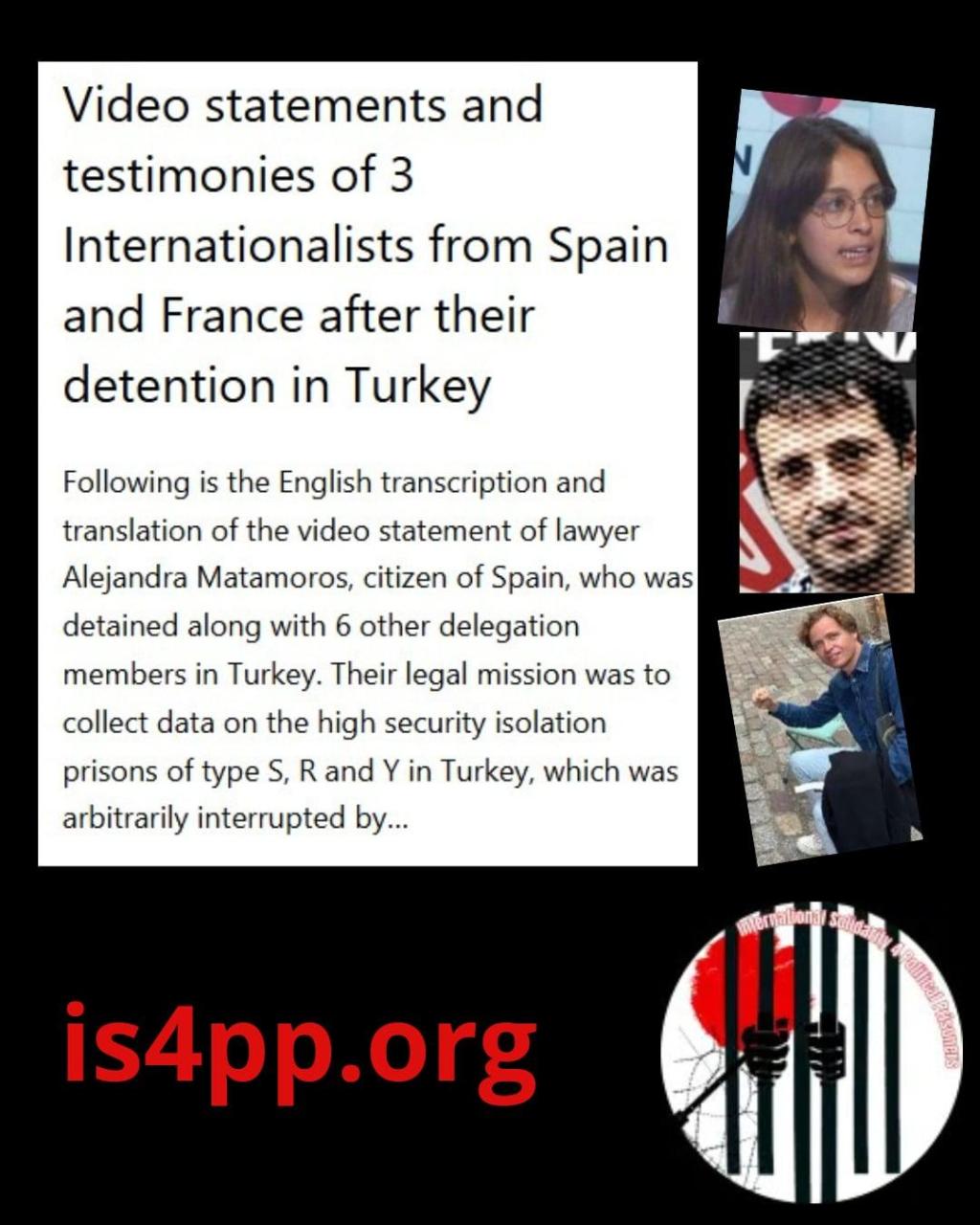
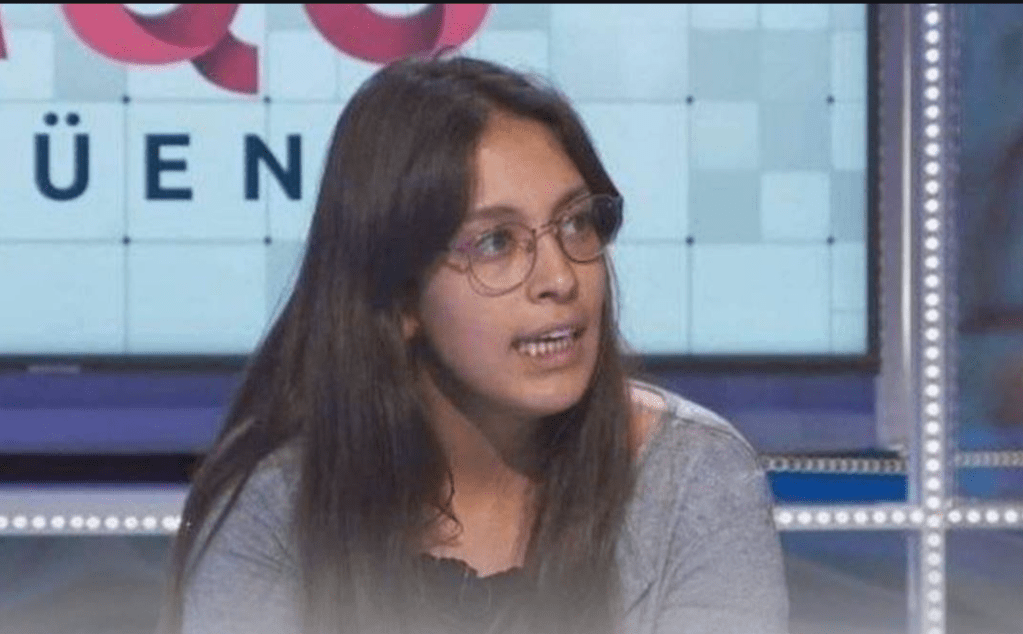
Following is the English transcription and translation of the video statement of lawyer Alejandra Matamoros, citizen of Spain, who was detained along with 6 other delegation members in Turkey. Their legal mission was to collect data on the high security isolation prisons of type S, R and Y in Turkey, which was arbitrarily interrupted by force through the Turkish authorities.
“Hello, I’m Alejandra. As many of you probably know, on February 18th, several people from different countries traveled to Turkey to see firsthand the situation of political prisoners there, specifically those held in the so-called “Well-Type” prisons. On the 19th, just a few hours after landing in Istanbul amidst a large police presence in the street, Turkish police arrested all members of our delegation in broad daylight. We were detained for several hours, practically a full day, during which time we were deprived of absolutely all our rights.
We were never informed of the reason for our arrest, we were not allowed to contact the Turkish lawyers present to provide us with legal assistance, we were not given consular assistance, and we were not provided with a translator in our native language, or any other language, to communicate with the Turkish police. During all the hours of detention, at least my companion and I were given practically no food and water. The treatment was quite unpleasant.
We wanted to denounce, aside from this arrest, which of course violates all legality, because we were there legally and were simply going to raise awareness about the situation, and we were arrested. We want to emphasize that the reason for our arrest is purely political. The Turkish state is arresting us because it wants to silence the situation of political prisoners there.
He doesn’t want the existence of these “well-type” prisons to be known—prisons that violate absolutely all rights, both international and many of the rights that prisoners in Turkey are theoretically entitled to. Finally, we also wanted to denounce the possible collaboration that we believe the Spanish State had in our arrest. The Turkish police knew our names beforehand, even our personal information; they came prepared to arrest us.
We understand that this information must have been provided thanks to the Spanish authorities. We also want to denounce the fact that my colleague Fernando García of the PCPE and I received absolutely no assistance from the Spanish Embassy and Consulate in Turkey. No consular officials came to visit us, despite repeated requests from our colleagues in Spain. The Turkish government, in theory, refused to provide any information to the Embassy and Consulate, and the Embassy and Consulate did absolutely nothing in response.
Therefore, we not only want to denounce the repression by the Turkish state, but also the collaboration of the Spanish state. This is not surprising to us, because obviously the Spanish state, as with political prisoners, as we have seen in recent days and as we already know, is complicit. For this reason, we believe it is very important to continue building internationalist solidarity against repression and against fascism.
For our part, we are clear that we will continue fighting and that they will not silence us, no matter what happens. Finally, I thank all the organizations and people who have supported us in recent days.
Thank you very much.” (Translated by deepl.com)
Video message in Spanish:
***
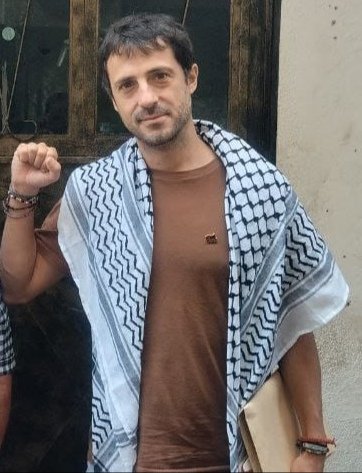
Video statement of Fernando Garcia, another international observer detained in Istanbul during their fact-finding mission concerning isolation (pit-type) prisons:
“First of all, I would like to send my regards and gratitude to all the individuals and groups that I know.
I heard you’ve been putting pressure on them, showing solidarity.
I am already on my way home.
In addition to an international delegation, we will learn about the repression against revolutionaries in Turkey, the situation of political prisoners, and maximum security prisons, known as pit type prisons.
At one point, after a meeting with a group of democratic lawyers, we were detained, sent to solitary confinement, and pressured to sign a statement agreeing to leave the country voluntarily, because in reality they have nothing probable, they cannot prove any serious accusations against these people in the delegation.
After a day and a half of pressure, of being isolated and denied any possibility of contacting the embassy, and of course also denied any possibility of contacting a lawyer, I finally ended up accepting the expulsion.
And nothing, above all and most importantly, because this is nothing compared to the repression and oppression that people, revolutionary activists, have to fight every day in Turkey and above all to express admiration for that struggle and also to clearly denounce these regimes of absolute repression against revolutionary movements, such as the Turkish regime, which stands out for exercising all kinds of repression and violence against activists, the second most powerful army in NATO.
Above all, we must also show obvious solidarity with political prisoners and demand an end to the different isolation regimes to which they are subjected, especially the harshest one, which we had planned to document, that of the Pit Type prisons. which, according to the testimonies we have had time to collect, are totally dehumanizing, with 23 hours of isolation per day, hardly any ventilation, no contact with other human beings, and no sensory stimulation, that is, physical and psychological degradation to which they are subjected and which this militancy is capable of overcoming.
So, greetings and an end to political prison regimes in Turkey and, above all, an end to Pit-type prisons.
Greetings.”
***
This is the testimony of Jean Pascal Graziani, member of the delegation who went to Turkey in the frame of a fact finding mission about the Pit Type Prisons:
Jean Pascal:
“This is a sum up of my two days. Tell me comrades if you have more details and we can write together sth we could use then
Arrival
• Night at home
• Transfer to the Lawyer’s Association office
• Meeting with lawyers
• Meeting with Umut
• Lunch
• Arrested
• 30 policemen (25 quite young, 5 hooded)
• Straight to anti-terrorist / passport control / medical arrest
• Videotaped at the bus stop
• Then to the Istanbul Department of Immigration
• Video prohibited
• Shared location
• Tried to turn off the phone and take it from my hands
• First location: lawyers
• First bus to medical stop
• Government seat of immigration
• Second bus with other arrested people
• Handcuffed with zip cuffs
• Transferred to detention camp
• Arrival: men and women separated.
Migration administration.
Name – last name – mother’s name / father’s name / fingerprints taken three to four times.
– Ragazzi
– Afghanistan
– Turkmenistan
– Kyrgyzstan
– Nigeria
– Syria
– Brought to locker room
– Phone taken
– Denied call
We stayed together.
Then, split: women and men.
– Arrested at 12:45
– Doctor around 1:30–1:45
– Immigration center at 2:00 p.m.
– Brought to camp at 2:30–2:45
– Administration until the end of the day
Disrespectful, violent, yelling, no translation.
They asked us to sign documents.
We refused. All six of us refused.
Nightfall in Istanbul on Wednesday was 7:11 p.m.
We were sent to the retention rooms around 6:30 p.m.
We stayed there roughly one hour.
The camp was the Arnavutkoy Removal Center, a temporary immigration camp known for organizing transfers out of the country.
Structures made of prefabricated containers.
Six people in each container.
Bunk beds.
Obviously not cleaned.
First room: with Basha and a Pakistani man.
About the people there:
– Lots of kids
– Babies
– No translation, never
Second wake-up.
At night, probably between 8:30 and 9:30 p.m., they woke us.
Brought us to registration.
– Asked us to sign
We refused again.
One woman was told she might stay a whole year if she did not sign and pay for the ticket back.
The document stated that we accepted to be returned to our countries, renounced the right to sue, and waived any judicial consequences regarding the arrest.
We stayed at registration one hour and a half to two hours.
Then brought back to our rooms.
We started to sleep.
Forty-five minutes later, they took us back again to registration.
We stayed there roughly 45 minutes.
There was a young German man — the only European we met in the camp.
After 45 minutes, we were sent back to the airport.
We were handled by the Gendarma (Jandarma), the airport police.
They were violent, yelling, threatening.
No calls allowed — not to the embassy, not to lawyers.
They asked us to sign.
The two of us refused again.
Four comrades were sent back to their countries.
Two comrades were sent back to the immigration camp.
We were sent to the same immigration camp but to another district.
We arrived there around 1:40 or 2:00 a.m., after spending about one hour at registration.
At registration, we met Ahmed.
We waited there a long time.
In the new district, we met people from Azerbaijan.
They gave us mattresses.
Later, the people — not the administration — brought blankets.
No toilets.
No shower.
Everything out of order.
In the morning, we spoke with people from Afghanistan, Syria, and Azerbaijan.
We were again refused a phone call.
People inside were extremely kind and friendly.
We were then taken by bus for about three minutes and sent back to the same district.
We spent another hour there.
They kept moving us back and forth, apparently on purpose.
One hour later, we were sent by bus to the registration center and from there to the airport.
The drive lasted 35 to 40 minutes.
At the airport, we saw Naim and Umut’s lawyer with two soldiers.
They did not see us.
– Sent underground directly, as the day before
– Around 11:00 a.m.
– Registration again
– Even more violent than the day before
Until that moment we were still together.
Then they decided to split us.
I didn’t see Fernando anymore at my side.
They played a good cop / bad cop game.
Something theatrical.
The bad cops were very aggressive.
One used Google Translate.
The others yelled and threatened, but never beat me.
– We understood we had some room for negotiation since they were not beating us.
They threatened me again.
Then the good cop came back.
The bad cops said I was making everything difficult.
They said I would stay for a long time.
They said everything would get worse and worse.
After about 40 minutes, the good cop returned alone.
He started talking to me.
Then a second good cop / bad cop game.
They threatened me again.
They decided to handcuff me.
They tightened the zip cuffs so violently that I could not feel my hands.
Since I was alone in the room, I tried to burn the handcuffs on the heater.
They came back.
They agreed to loosen the zip cuffs.
They said they did not understand why I was resisting.
They said I was a threat to public order.
They said I should pay for my ticket to go back that same day.
They frightened me again.
They left.
Then the good cop came back and spoke to me through Google Translate.
His questions were about what I actually wanted.
I repeated what I wanted:
– Call the embassy
– Call my lawyer
– Have my return ticket covered
– If none of this was possible, send me back to the camp
They said all of that was impossible.
The good cop said I could not see my lawyer because he was not allowed to enter.
He said this place was an “international zone” and access was forbidden.
I answered: my lawyer was at the entrance of the building.
He was on the other side.
He asked, “How do you know that?”
I said: because I saw him when we arrived.
The last time the bad cops came back, they were more violent.
The man who had been punching his fists earlier was now clearly the leader.
He asked me to sign the document.
I refused.
He showed me a document saying that Fernando had signed.
It contained only one sentence:
“My name is Fernando Garcia and I want to come back to Spain.”
I refused again.
He became very upset.
He said this time it would be violent.
I said:
– I want to call my embassy
– I want to call my lawyer
They said it was impossible.
I said:
– My flight is in two days.
– Leave me anywhere you want. I will leave when my flight comes.
They said the Turkish authorities had definitively cancelled my flight.
I said it was not my problem.
They threatened me.
– I said: this is your problem.
– If you want to beat me, do it.
– If you want to expel me, do it.
– I book nothing. I sign nothing.
– I have a flight in two days.
They said: “Okay, we’re going to put you in a straitjacket.”
It was about 3:30 to 4:00 p.m.
I did not resist while they put the straitjacket on me.
– They put a zip cuff on my ankles. It stopped the blood. Later, I could not walk properly.
– They put a restraint around my knees.
– They forced a straitjacket onto me while beating me.
– They put a restraint across my chest and arms.
– They tied me to a chair.
– They put a zip cuff on my wrists.
They were beating me, although I was not resisting.
– One of them whipped me with zip cuffs.
– The movements were half beating, half sexual in nature.
– He whipped my back with the plastic cuffs.
Then they left.
I waited like that for a couple of hours.
I eventually slept, but it was difficult because of the zip cuffs on my ankles.
Later, near the end of the day, the good cop came back.
We were still in that room, around 100 square meters.
He came with another officer who untied me.
He used Google Translate.
He asked: “Why are you like this?”
– I said: I am not doing anything.
He said: “I can help you, but you are making things complicated.”
I repeated:
– I want to call my embassy.
– I want to call my lawyer.
He said it was absolutely impossible there.
I said: I do not sign anything.
He said: “Just write: I want to go to Milano. You don’t even have to sign.”
I said: I don’t sign and I don’t pay. Is that okay?
He said yes.
He even pretended he would pay for me.
I did not sign any document.
They paid for the ticket.
I believe I was not expelled through a regular legal procedure.
The flight left at 9:40
I was not allowed to use my phone until I was inside the plane”
 INTERNATIONAL SOLIDARITY FOR POLITICAL PRISONERS (IS4PP)
Leave a comment