
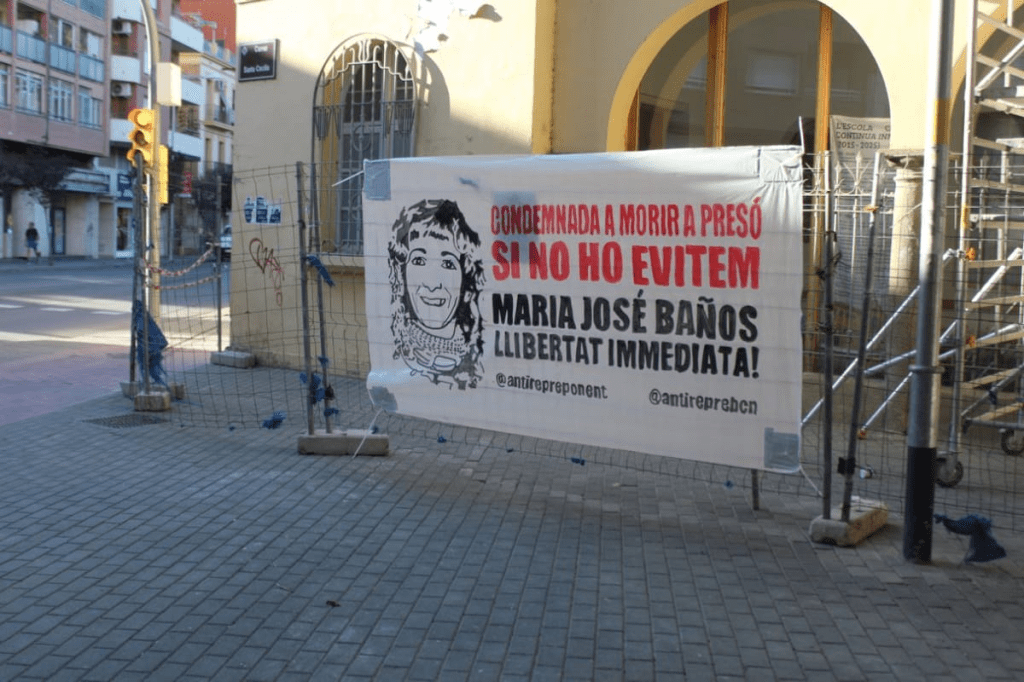
OPEN LETTER TO THE INTERNATIONAL LEGAL COMMUNITY concerning the ongoing violation of the fundamental rights of political prisoner María José Baños Andújar.
To the attention of solicitors and barristers, Bar Councils and Law Societies, legal and human rights organisations, Special Rapporteurs, and European and international mechanisms for the protection of fundamental rights.
The undersigned – jurists and legal professionals from various jurisdictions – address the international legal community in order to publicly denounce the severe, ongoing, and structural violations of the human rights of political prisoner María José Baños Andújar, who is currently deprived of her liberty by the Spanish State, notwithstanding that she suffers from a number of serious and incurable illnesses, extensively documented by medical reports and administrative decisions.
This complaint is advanced from a strictly legal and human rights–based perspective and is grounded in the European Convention on Human Rights (ECHR), the jurisprudence of the European Court of Human Rights (ECtHR), the Charter of Fundamental Rights of the European Union, the European Prison Rules, and other international instruments binding upon the Spanish State.
I. PERSONAL AND MEDICAL CIRCUMSTANCES
María José Baños Andújar, aged 61, is serving a lengthy custodial sentence due to expire on November 2027, having served well in excess of three-quarters of that sentence since November 2018.
She suffers from a number of serious and chronic medical conditions, including:
-HIV infection, Stage C3
-Chronic thrombocytopenia
-Severe intermittent claudication with progressive arterial deterioration
-Multiple arterial and muscular calcifications
-Severe caloric malnutrition
– Respiratory disorders requiring oxygen therapy
-Multiple hepatic and cardiovascular conditions.
The competent health authorities have confirmed severe weight loss, a substantial reduction in mobility, a generalised deterioration of her physical and mental condition, and the inadequacy of the custodial environment to provide appropriate medical care.
In November 2024, the public authorities formally recognised Ms Baños Andújar as having a 69 per cent disability.
Her legal representatives have applied to the Prison Supervision Court of the Audiencia Nacional for conditional release on medical grounds. A determination is currently pending. Notwithstanding this, the same judicial body refused conditional release more than one year ago, despite formally acknowledging the seriousness of her medical condition.
II. REFUSAL OF HUMANITARIAN MEASURES AND REQUIREMENT OF IDEOLOGICAL REPENTANCE
Despite this severe clinical picture, the prison authorities have refused progression to open conditions (third degree) and conditional release on grounds of serious and incurable illness, based exclusively on the absence of ideological repentance, without asserting dangerousness, risk of reoffending, or any medical, security, or disciplinary justification.
Such a requirement amounts to:
-A condition not prescribed by law
-An unlawful interference with freedom of thought and belief
A distortion of the humanitarian purpose of release mechanisms based on serious illness.
III. BREACHES OF THE EUROPEAN CONVENTION ON HUMAN RIGHTS
1. Article 3 ECHR – Prohibition of inhuman or degrading treatment
The settled case law of the European Court of Human Rights establishes that the continued detention of a seriously ill person, where the State is unable to provide adequate medical treatment or where detention exacerbates suffering, may constitute inhuman or degrading treatment.
Judgments such as Kudla v Poland, Mouisel v France, Gülay Çetin v Turkey, and Tekin Yıldız v Turkey confirm that States owe an enhanced positive obligation to persons deprived of their liberty.
The continued imprisonment of María José Baños Andújar, given her current health condition, exceeds the inevitable level of suffering inherent in detention and therefore breaches Article 3 of the ECHR.
2. Article 2 ECHR – Right to life
Where continued detention gives rise to a real and foreseeable risk to life, the State fails in its positive obligation to protect life. Progressive malnutrition, accelerated systemic deterioration, and the absence of adequate medical supervision create a life-threatening situation incompatible with Article 2 of the ECHR.
3. Article 8 ECHR – Right to respect for private and family life
The refusal to permit a seriously ill individual to confront the terminal deterioration of her health outside the custodial environment, in conditions of dignity and family support, constitutes a disproportionate interference with her right to respect for private and family life.
4. Articles 9 and 10 ECHR – Freedom of thought, conscience, and expression
Making access to humanitarian measures conditional upon expressions of repentance or the renunciation of political beliefs violates the freedoms of thought and conscience protected by Articles 9 and 10 of the ECHR and by the EU Charter of Fundamental Rights.
IV. EUROPEAN PENAL AND PRISON STANDARDS
The European Prison Rules (Rules 39, 43, and 47) provide that:
-Health care for persons in detention must be equivalent to that available in the community.
-Imprisonment must not be used as a means of unnecessary suffering.
-Alternatives to detention must be adopted where continued incarceration is incompatible with human dignity.
European penal law further recognises that the rehabilitative purpose of punishment is wholly undermined where a sentence becomes purely afflictive, particularly in cases of irreversible illness.
V. ESTABLISHED VIOLATIONS
1. Breach of Article 3 ECHR
The continued deprivation of liberty in the presence of a documented serious and incurable illness, progressive physical decline, and the structural inability of the prison system to provide adequate medical care amounts to inhuman and degrading treatment.
2. Breach of Article 2 ECHR
The State has failed to take reasonable and effective measures to avert a real, immediate, and foreseeable risk to life.
3. Breach of Article 8 ECHR
The denial of humanitarian release fails the proportionality test and serves no legitimate penological objective.
4. Breach of Articles 9 and 10 ECHR
The imposition of ideological repentance as a precondition for humanitarian relief constitutes an unlawful interference with freedom of conscience and expression.
5. Breach of the principle of legality and of human dignity
The imposition of conditions not prescribed by law violates legal certainty and fundamental principles of human dignity, as enshrined in Article 1 of the EU Charter of Fundamental Rights and Article 10(1) of the Spanish Constitution, interpreted consistently with the ECHR.
6. Non-compliance with European Prison Standards
The conditions of detention are incompatible with the European Prison Rules, in particular those requiring equivalence of medical care, the adoption of alternatives to detention on health or dignity grounds, and the prohibition of purely punitive or exemplary penal regimes.
VI. CONCLUSION AND CALL
The circumstances of María José Baños Andújar do not constitute an isolated case, but rather a paradigmatic example of the use of imprisonment as an instrument of political punishment, in manifest contradiction with fundamental rights and democratic principles.
Accordingly, we call upon:
-the authorities of the Spanish State to adopt immediate humanitarian release measures
-European and international human rights mechanisms to actively monitor and scrutinise this case
-the international legal community to endorse and spread this complaint in defence of human dignity.
Deprivation of liberty must not be transformed into a covert death sentence, nor may ideological repentance be imposed as a condition for the enjoyment of fundamental rights.
Signatories:
(Name – Profession – Bar / Organisation – Country)
This letter remains open for endorsement and signature by jurists, organisations, and legal professionals at the international level.
 INTERNATIONAL SOLIDARITY FOR POLITICAL PRISONERS (IS4PP)
Leave a comment