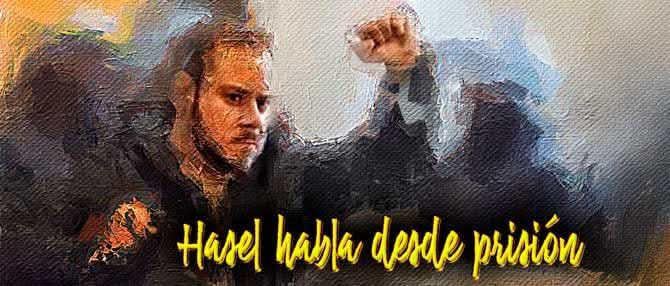
Pablo Hasel: ‘I’d rather leave prison later, but without having given them what they want.’
Interview with Pablo Hasel
‘I’d rather get out of prison later, but without giving them what they want.’
Interview with the rapper, who is facing the final stage of his imprisonment after five years.
Last month marked five years since the imprisonment of the rapper Pablo Hasel, convicted for the lyrics of his songs and a few tweets published some time ago. Initially, the sentence was nine months in prison, but the accumulation of several cases meant that, in total, he still has a year and a month of his sentence left. This is, therefore, the final stage of his imprisonment, which the artist has decided to face without applying for third-grade status. ‘I renounce the repentance and cooperation they demand of me to access it,’ he explains.
His second poetry collection, Prova de vida, will be released soon, around St George’s Day, and also serves to prepare the campaign for the end of his six-year prison sentence.
We speak with him about all this; he remains firm and focused on collective struggles, despite the weight of enduring year after year of strict imprisonment.
Conditions have improved slightly with the transfer to Lledoners prison, but he still highlights its harshness and criticises the narrative that portrays prison as if it were a hotel. This interview had to be conducted by post, and all of Hasel’s written content has been respected.
— How are you? How are you coping with prison after five years?
With the strength to continue resisting, and that is the most important thing. Logically, I am concerned about the international, state and national context: imperialism continues to aggress brutally and we pay for its rearmament, the genocidal and torturous occupation of Palestine continues, living conditions are getting worse every day, repression shows no sign of stopping and they are exterminating seriously ill political prisoners – such as María José Baños – the influence of fascism is spreading and firm resistance to all this is still small. This context drives me to redouble my efforts in the struggle.
As the years go by, prison weighs more heavily, but at the same time, you “get used to it”.
— What was it like moving prison, from Ponent to Lledoners?
This prison is much newer and the facilities are better.
It doesn’t have the massive infestations of cockroaches, bedbugs and rats that Ponent does. Even the prison officers’ unions have publicly denounced that the Lleida prison has “subhuman conditions”. There, three people have been put in tiny cells and there isn’t even the mandatory buzzer to call for help in an emergency.
It’s literally falling to pieces and, as a well-placed worker from Ponent told me, ‘if there were a decent judge, they’d shut this prison down immediately’. But here the food is the same rubbish and, with a chronic intestinal illness like mine, it’s especially fucked up and has negative consequences.
Lledoners is also a prison, with everything that entails, and there isn’t a single one that’s anything like a pleasant hotel, as many outlets of disinformation would have you believe.
— Do you have the same restrictions as in Ponent prison, such as the ban on recording songs?
The decision to deny me the musical activity of recording songs, to which the other prisoners are entitled, is down to the Prison Service, so they don’t allow it here either. Even songs without any protest content. It’s just another punishment for not bowing my head.
— Are you still refusing permission and third-grade status? What political reason is behind this?
I renounce the repentance and collaboration they demand of me to gain access. Any political prisoner who does not renounce the struggle for which they were punished receives no prison benefits. Without proven domestication and an explicit commitment not to return to it, there is no “reward”.
History has shown – as with the collaborationist leaders of the process – that surrender stops struggles, but that, on the contrary, consistent firmness drives them forward. I am proud to be a revolutionary and I do not intend to legitimise the repression by condemning this struggle. That would be to betray the collective cause and to betray myself, my conscience. I would rather leave prison much later, but with my head held high, without having given them what they want. What good would it do to get out sooner if I could not then look myself in the mirror? They alone must repent for so much oppression, for the greedy and criminal policies that destroy the lives of millions of people.
Political prisoners must be freed through solidarity and total amnesty. Not through an individualistic surrender that represents no real liberation.
— Although there was a great social response and a strong political reaction to your imprisonment, five years on no pardon has materialised, nor has there been a reform of the penal code regarding crimes of opinion. How do you assess this, and what political responsibilities does it entail?
I believe that if the protests had continued for more days and with greater intensity, the repeal of some expression offences would have been achieved, my release secured, and the cases against comrades accused of identical charges dropped.
But there was a lack of organisation, which is the key to everything. Also, more sustained social pressure later on. This doesn’t mean that everyone has stopped showing solidarity with me, only that it has been insufficient. There are too many repugnant complicities, also in the world of art and culture, which is rotten with mercenary individualism. I never asked for a pardon, but the Catalan Academy of Musicians did, and Unidos Podemos promised it.
In the second case, it was a manoeuvre to stop the street protests, which made the regime very nervous, because they were not only pointing out the lack of freedom of expression, but also the lack of many other freedoms and rights. These opportunistic charlatans not only failed to free me, perpetuating repressive laws they had promised to repeal, but they also passed more, such as the digital gag law or the national security law, and increased the repressive budget. Aided by the crutch of their partners who, after almost a decade of supporting fascist laws, now come with the fear of fascism to win votes. The false progressives also repress anti-fascists while granting impunity to fascism, even the most violent.
— You are soon to publish a new poetry collection, Proof of Life. What did you want to pour into it? Does the idea of a ‘proof of life’ refer to the feeling of political oblivion?
Throughout this long abduction, you have to provide proof of life. Like so many other victims of repression, they have tried to destroy and nullify me in many ways. It’s a way of remembering that they haven’t succeeded. They’ve ruined my health, but my consciousness has grown stronger. Committed poetry, as part of the struggle, is explicit proof of life. And yes, it is also a tool to counteract the invisibilisation to which revolutionaries like me are condemned. Both by the most brazen fascism and by the domesticated ‘left’ and the collaborationist processism. The book contains many poems about prison and resistance, but also on other themes.
— Is writing in Catalan now –this is your second poetry collection– also a decision that has to do with a certain kind of activism?
Yes. In the introduction to my first poetry collection in Catalan, Erosionant murs, I practise some self-criticism and explain that I should have written more in Catalan.
Not only to defend the language of our land, often as under threat as the rest of our national rights and freedoms, but also because Catalan has been and is part of my life experiences, in which I have used it a great deal. Spanish is my mother tongue and most of the music I’ve listened to or the majority of things I’ve read have been in that language, which is why it comes more easily to me, but Catalan also inspires me for the very same reason, and my insecurity prevented me from using it more when creating art.
Until I told myself it was time to take the plunge.
— How does writing help you in prison?
It’s a great outlet and a distraction. It’s also a way to keep your mind working, which can easily go rusty in here. At the same time, it’s a contribution to the outside world to spread the message, raise awareness and spur urgent action.
— How are you approaching this final year of your sentence? What’s your vision for your return?
Making the most of the time, as I said. As for the return, like any prisoner who has spent many years locked up, I’m a bit worried about adapting, but I’m really looking forward to being with the people I love, doing lots of things I can’t do here, and continuing to contribute from another front.
 INTERNATIONAL SOLIDARITY FOR POLITICAL PRISONERS (IS4PP)
Leave a comment