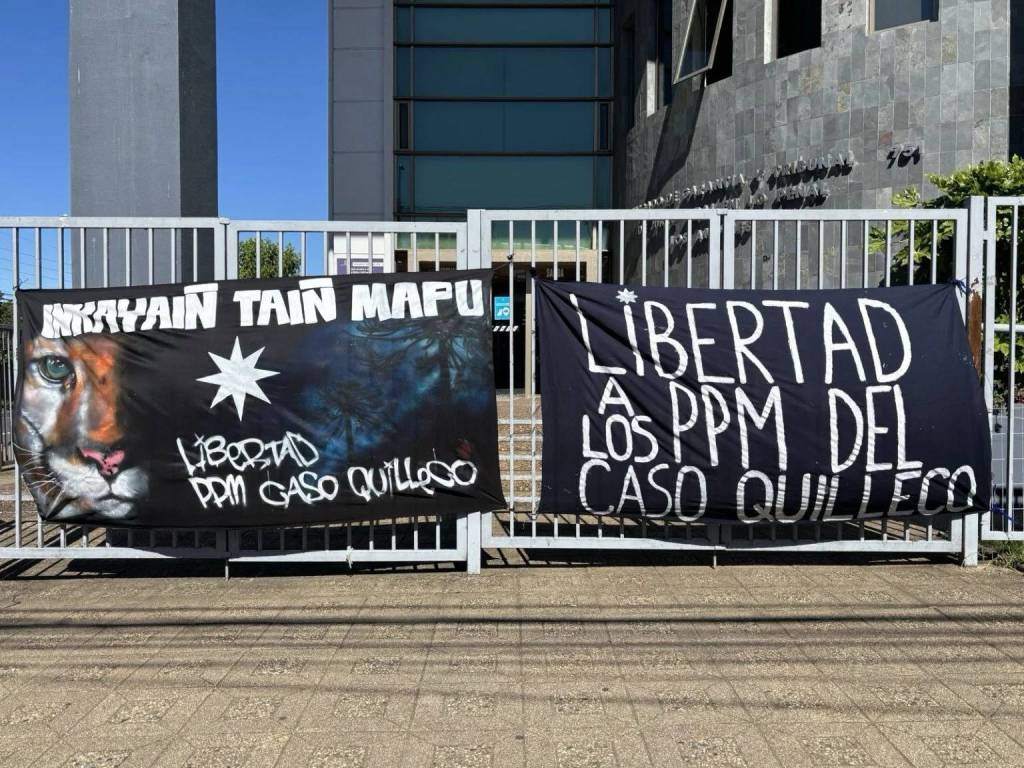
Quilleco Case
The Hunger Strike of Five Mapuche Political Prisoners Under International Scrutiny
An international delegation of observers arrived in Temuco (Araucanía Region, Chile) amid growing questions about the Chilean state’s handling of the so-called “Quilleco Case,” a case that has once again brought historical tensions with the Mapuche people to the forefront of public debate. The delegation—whose participation is sponsored by Fundalatin—is composed of lawyer Gabriela Conder; Isabel Vileya, representing the organization; and Eduardo Soares, representing the Argentine Lawyers’ Association.
The Quilleco Case dates back to two arson attacks against forestry equipment in the municipality of the same name, in the Biobío Region, for which seven Mapuche community members were sentenced to prison terms of up to 17 years.
However, the defense and support organizations denounce that the trial was based on insufficient evidence, protected witnesses and questionable procedures, which has led to the filing of appeals for partial annulment before the Supreme Court.
International Observation and Complaints
The international mission has focused on alleged judicial irregularities, the use of protected witnesses, the imposition of harsh sentences that exceed the standards of Chilean law, and the impact of the hunger strike, which has already caused evident physical deterioration in the imprisoned Mapuche community members: Óscar Cañupan, Bastián Llaitul, José Lienqueo, Roberto Garling, and Axel Campos.
More than a Month on Hunger Strike
In this context, five of the convicted men are maintaining a prolonged hunger strike—more than a month—as a form of protest to demand the partial annulment of the trial and humane prison conditions.
Reports from international organizations and visits by lawyers warn of significant weight loss and a “complex” state of health, which increases concerns about potential violations of fundamental rights.
In this context, we spoke with Isabel Vileya, coordinator of Fundalatin Chile, and Maruxa Silva, a member of the same organization, who analysed the international scope of these allegations, the role of observers, and the political and legal implications of a case that could escalate beyond Chilean borders.
In the context of the Quilleco case, what is the central objective of your visit as an international delegation?
The main objective is to verify prison conditions and exchange information on the legal situation, taking into account the opacity and repression faced by the Mapuche community, especially those deprived of their liberty.
In your preliminary assessment, are there indications of irregularities or violations of due process in the Quilleco case?
Absolutely. A sentence based on the testimony of protected witnesses, and one that dismisses the expert reports prepared by the Chilean Investigative Police themselves because they resulted in the exoneration of the accused, is clearly a case manipulated to incriminate and convict Mapuche political activists.
What is the current status of the hunger strike being carried out by the political prisoners?
The current phase, now a month into the protest, has entered the secondary phase, so to speak, characterised by muscle loss and organ damage. Despite their worrying medical condition, the prisoners are in enviable spirits.
What are the main demands of the hunger strikers?
The main demand is aiming at the partial annulment of the case, which would lead to a reduction in their sentences. They are also demanding transfers to prisons closer to their families and, finally, prison conditions that respect the physical and spiritual integrity of the prisoners.
How do you assess the state’s response to this hunger strike?
The Chilean State completely ignores the demands of the Mapuche Nation, dismissing dialogue and negotiation regarding the right to self-determination. In the same way that the Chilean State ignores these demands, it hides and silences all actions derived from the situation described above.
Are there sufficient medical guarantees for those on hunger strike?
Absolutely not. There is no medical or healthcare assistance at the Temuco Penitentiary Center. The WHO recommends that the prison population receive the same care protocols as the general population. In Chile, there is a ratio of 1.3 doctors per 1,000 patients. This is clearly insufficient for the incarcerated population. There are only 45 doctors for a national prison population of 50,000.
This leads to critical situations in which the lives of inmates are constantly exposed to the harshest realities of their situation. It is important to remember that, according to international treaties, deprivation of liberty does not, or should not, limit civil rights.
In this specific case, what role have human rights organizations played?
Without the involvement of the Fundalatin Foundation, which has consultative status with the United Nations, and the technical support of the Maruxa Silva Civil Defense Association, we believe the authorities’ willingness to collaborate would have been different.
Based on what we have observed, what preliminary recommendations does the delegation make?
The urgent priority is undoubtedly to raise awareness of the issue, internationalise it, and disseminate it widely as part of a strategy to open up the Mapuche problem, and to encourage the intervention of international organizations and, above all, international grassroots support networks.
What urgent measures do you consider necessary to address the current situation?
The urgent thing is to recognise that this case stems from the need to decolonise the world. This is a consequence of five centuries of land distribution that marginalized its inhabitants, trampling over entire communities to commodify life, and it won’t be resolved in the Chilean Supreme Court, nor does it fall under the Quilleco Case. But, in any case, this case confirms that there is an underlying political conflict, and these cases are clear proof that the lives of oppressed peoples—in this case, the Mapuche—are subject to the interests of people who have no qualms about condemning them to misery, imprisonment, and suffering in order to continue accumulating capital.
Finally, what message do you seek to convey to the international community about what is happening in this case?
The fundamental thing is the acknowledgement of the Mapuche Nation ́claims, their right to resistance, their steadfastness, and their will to fight. The prisoners in the Quilleco case, like so many other incarcerated people, are worthy representatives of their people, custodians of their tradition of struggle and resistance, and I think that under no circumstances should they be referred to by any other term than weichafe (fighter).
 INTERNATIONAL SOLIDARITY FOR POLITICAL PRISONERS (IS4PP)
Leave a comment