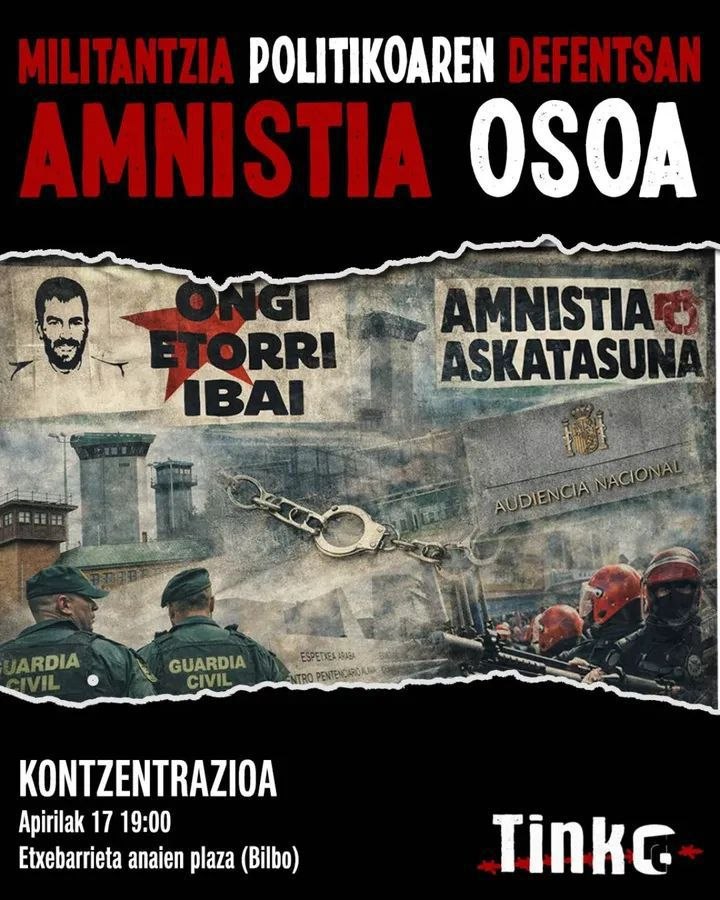
INTERNATIONAL DAY OF POLITICAL PRISONERS
The Basque Political Prisoners Garikoitz Etxeberria, Jon Kepa Preciado, Patxi Ruiz and Mikel Sansebastian sent a statement for the International Day of Political Prisoners, mentioning very actual prisoners’ resistances in several countries.
Oppression and brutality are among the main components for the survival of Capital, which we can find all over the world and which have harsh effects on millions of people.
Today, on the International Day of Political Prisoners, the day for political militants around the world imprisoned for fighting for the political and civil rights of the working class and oppressed nations, we wish to denounce the violence systematically used by States under capitalism against those fighters held in their prisons.
Among the most egregious cases is that of Palestine, where, with the support of the US and the collaboration of Western states, Zionism tortures thousands of women, men and children in its prisons—people it has not succeeded in killing.
.
In Ireland, violations of the rights of political prisoners continue to this day. Among other things, the British change the law when necessary to delay the release of republican prisoners.
In Turkey, some communist prisoners have been on hunger strike for over 200 days to protest the appalling conditions they endure in what are known as ‘tomb prisons.’ In India, since January, political prisoner Pramod Mishra has been on an indefinite hunger strike to protest the appalling living conditions suffered by political activists held there.
In the Sahara, as in Palestine, the offensive waged against the entire people is also endured in the prisons. Sahrawi political prisoners have been fighting with dignity against Moroccan repression for decades.
The repression and injustice suffered by antifascist political prisoners in Ukraine have been completely silenced.
Last March in Jordan, Dahan Al-Amoush, a Jordanian engineer, died in prison as a result of a hunger strike he was on. Dahan Al-Amoush was imprisoned for expressing solidarity with the Palestinian people on social media.
He alleged that he had been tortured. Indeed, he launched a struggle to denounce his situation.
Mumia Abu-Jamal has been held captive in the US since 1981; he is the longest-held political prisoner in the world. Of those 45 years, he has spent 29 on death row, and is currently serving a life sentence.
It is no surprise that this is happening in the centre of the Capital. The violence against the revolutionary activist Gabriela Gallardo in Ecuador shows no sign of stopping. Gabriela has a brain tumour, which is why she was released. But she was later jailed again, despite there being no change in her health condition.
At present, she is not receiving any treatment for her illness in prison. In Paraguay, another case of injustice has long been unfolding: that of the communist political prisoner Carmen Villalba. Carmen is seriously ill and is being held in solitary confinement, which is even more detrimental to her health. Francisca Andino and Laura Villalba, Carmen’s sisters, are also being held in isolation.
Enduring such policies continuously for many years has a significant impact on health. The intimidation imposed on militants with serious mental and physical illnesses is a pillar of the policy against political reprisals.
This year, in the Spanish State, the case of the antifascist activist María José Baños Andújar has become a clear example.
We will never see the violence that is structurally imposed in prisons in the media, and those who lose their lives behind these walls will receive no recognition from the institutions.
States that consider themselves democratic enable repression and vulnerability in prisons for their own interests, a fact that is even clearer in the case of political prisoners.
We have mentioned only a few cases here, but conflicts and repressive attacks are numerous around the world, as are the different forms of resistance and struggle against them. It is from those who take up these responses that political prisoners are born.
Although the situations in each place may be very different, we all share the same spirit: we not only maintain what we proclaimed on the streets, but we also fight for decent living conditions inside, whilst at the same time demanding Full Amnesty.
With the prison as our field of struggle, we hold fast to our ideas and principles, with the aim of overcoming the violence, policies of revenge, and states of exception we receive from the oppressors. We are not alone in this struggle, and street organisations, solidarity networks and militants support us in confronting this machine of repression, as well as in spreading our voice.
We would like to praise the work and commitment of every militant on the other side of the wall, because thanks to them our contributions, demands and communications about our situation travel across the world, and our struggles need their generosity to be effective.
Finally, a tight hug from the Basque Country to all the revolutionary political prisoners who remain in resistance around the world. Specifically, to those militants who, without giving up, make their contributions to changing the world itself by dignifiedly confronting repressive policies every day.
All Revolutionary Political Prisoners in the World Out!
Full Amnesty!
Basque Political Prisoners
Garikoitz Etxeberria, Jon Kepa Preciado, Patxi Ruiz and Mikel Sansebastian.


Leave a Reply