Izpine Bidaurrazaga (Aske): “Political activism aimed at independence and socialism is being criminalised”
25 November 2026 – Sare Antifaxista
Juanjo Basterra – Basque journalist and social scientist
Izpine Bidaurrazaga, a member of Aske, an organisation within Jardun Koordinadora, speaks to Sare Antifaxista following the imprisonment of Malen G. and Aratz B. by the Spanish National Court on charges of “terrorism”, despite the allegations not being substantiated by the evidence presented, according to the interview.
Bidaurrazaga warns that the entire operation seeks to “criminalise political activism and punish it as though it were terrorism”, using “supposed evidence” which, in reality, has no foundation, as their lawyer has already pointed out.
They will continue to publicise the arrests and provide support to the families and “the two people kidnapped by the Spanish State and held in a Madrid prison”.
Furthermore, she explains: “We are going to develop our campaign within this framework so that people understand that what has been done is unacceptable.” Euskal Herria has experienced similar cases in the past.
Almost a month after their arrest, following their voluntary surrender to the Ertzaintza (Basque police force), how are Aratz B. and Malen G.?
Malen and Aratz are currently being held in Estremera Prison in Madrid. Aratz is being held in an isolation cell, while Malen, because there are no isolation cells for women in that prison, is being held in the admissions wing.
As a result, her rights are being restricted even further. Prisoners in isolation are entitled to four hours of time outside their cells, but Malen’s time is constantly being reduced. Sometimes she is allowed out for only 30 minutes, and on some days she is not allowed out at all.
All of this also affects telephone calls. When there are many new admissions and the prison guards are busy, she is not allowed to make calls. This right is also being restricted and curtailed.
The applications they have submitted requesting that friends, in addition to family members, be permitted to visit them have still received no response.
To this day, none of their friends can visit them. This severely restricts their communication, as only their families are permitted to visit, with all the financial costs and risks involved in travelling by road.
The National Court has acted as it did years ago. Has their situation changed since they entered prison?
No. For the time being, they remain in isolation until further notice, and there are no immediate prospects of their being transferred to prisons in Euskal Herria.
Everything is being handled by the National Court, and they have been placed under the FIES regime, the anti-terrorism prison regime. Consequently, all their communications are recorded. This also constitutes a violation of their privacy.
Their lawyer has not yet been accredited by the prison. He is still waiting. He has been accredited by the National Court, but not by the prison. He cannot visit them.
It is as though we are back in the last century. What do you think of the Security Minister’s statements following the arrests?
We already know how the repressive forces of the Spanish State operate. What is being criminalised here is political activism.
Ultimately, among the accusations made against Malen and Aratz is, for example, the possession of weapons and explosives. This emerged during their statements, and the accusation was justified with a video showing how a fire extinguisher is filled with paint.
It is clear that what is being criminalised here is political activism, and they want to punish it as though it were terrorism.
It makes no sense whatsoever, and this supposed evidence has no foundation.
Do you believe that the Ertzaintza has acted as a force of the State?
Yes, as the repressive force that it ultimately is.
What is your assessment of their imprisonment, given that it will affect your organisations, Jardun, Aske and Jarki?
Our analysis is what I have just explained: they want to criminalise political activism whose objective is independence and socialism.
Ultimately, they are succeeding in doing so because they are categorising actions as terrorism when there is no basis whatsoever for describing them as such.
The actions they are referring to have no foundation as terrorism. As I mentioned regarding the fire extinguishers and the alleged explosives, these accusations have come to nothing. They have no basis.
Some disinformation outlets have directly accused them of “terrorism”. What do you think of this campaign against Aske and Jardun?
They have certainly used these arrests to criminalise Jardun.
We have seen numerous outrageous accusations against Jardun in the press, and a media campaign is being conducted by the Spanish media to criminalise our organisation.
What we must do is withstand it and confront it through interviews such as this one, in an effort to convey our message to Euskal Herria.
Why do you think they have decided to take this step now, given that you have been active for several years?
I believe that Jardun’s relationship with the State is ultimately based on confrontation.
The Spanish and French states therefore consider us a “danger” because our work at present is the ideological struggle.
We want the Basque Working People to understand that we are living through a period of widespread assimilation and that we must confront it.
People must develop their political consciousness and organise themselves.
That is Jardun’s work, and I believe that both the Spanish and French states see a danger in this organisation. That is why they want to deliver a repressive blow to see whether they can prevent us from continuing along this path.
But will you continue?
Of course. That is what we must do.
Everyone knows when they begin political activism that repression exists and that it is something they will have to live with.
However severe the blow may be, you must continue for yourself, your organisation and your comrades.
Regarding Ireland, which they have also mentioned, is this connected to your solidarity work? Are they attempting to establish some form of involvement?
It is yet another element.
The Spanish State opposes our organisations because of the danger it believes we represent, and the same thing happens in Ireland.
That is why they are also attempting to criminalise it. It is the same situation as we are experiencing here.
Are they trying to associate you with the New IRA?
Yes, precisely. It is all part of the narrative they are constructing.
What do you think of the lack of reaction from political organisations in Euskal Herria, given that this police fabrication undoubtedly sets a precedent?
It is true that, during the demonstration we organised in Bilbao on 31 October, we received considerable solidarity from social organisations, including occupied youth centres, youth assemblies and politically active football supporters’ groups.
However, it is also true that there has been silence from certain people who have preferred to look the other way because it does not directly affect them.
They have neither responded nor taken a position in any way.
Is there a particular reason for this?
I do not know.
I understand that perhaps they disagree with Jardun’s ideology or political direction, and that this may be why they have sought to distance themselves.
However, I also believe that when faced with such a serious case of repression, even if you do not agree one hundred per cent with the ideology of an organisation or collective, it remains a case of repression, and solidarity must be shown.
What is Aske? What is Jardun? What is Jarki? What are your objectives?
Jardun’s objective is to coordinate different organisations so that they pursue a common strategy.
We understand that the struggle to achieve independence and socialism is extremely broad and encompasses many different areas.
We believe that a single organisation cannot undertake all these struggles simultaneously because the burden would be too great. It is therefore necessary to divide the struggle into different areas, while ensuring that all these organisations move in the same direction and follow a common political strategy.
Jardun is therefore a coordinating body encompassing several organisations with a common objective: organising the struggle across different sectors to achieve better results in each area.
And Aske?
Aske is the anti-repression organisation. One of its objectives is to bring the demand for amnesty back onto the political agenda.
It is responsible for responding to the repression suffered by the Basque Working People and for confronting the repression directed against Basque political prisoners.
Jarki, meanwhile, is the ideological driving force. It is responsible for ensuring that all the organisations within the coordinating body follow a common strategy and for establishing the general ideological line.
What is your strategy at present?
As I mentioned earlier, it is primarily the ideological struggle.
In Euskal Herria, there was previously a political bloc that had a strategy but subsequently abandoned it.
This created a political vacuum in which the struggle for independence and socialism, based on confrontation with the State, has to some extent been lost.
Confrontation does not mean violence. What it means is that our approach is not based on cooperation with the State.
That is our strategy.
What exactly do you mean?
What we want is a country that is free both nationally and socially.
Cooperating with certain sectors ultimately makes no sense because it will not benefit us. What you are doing is a favour to the other side.
Do you believe that participating in the Congress and Senate in Madrid advances the struggle?
This is partly my personal opinion, but you can participate in Congress and the Senate as a means of using them as a tool, provided that your struggle remains in the streets.
They must be a tool, not the objective itself.
It is similar to a trade union, which you can use as a tool to achieve certain objectives of your political project. However, it must never become the vanguard of the organisation. That role must belong elsewhere.
Is that tool useful at present?
No, not at present, because although you are there, you are not advancing the objective of achieving a free, independent and socialist Euskal Herria.
Aske’s objective is amnesty. How many Basque prisoners remain in prison outside what was the EPPK (Collective of Basque Political Prisoners)?
I do not have precise figures, but I would say approximately 15, plus these two now.
We maintain relations with some of them, although this is also somewhat difficult.
Is amnesty necessary in order to make a fresh start?
Yes, it is necessary, but it must be understood as a transformation in people’s consciousness and mentality, so that they recognise that the struggle carried out by those currently in prison is lawful and legitimate, and so that there will be no need for further amnesties.
In other words, we understand amnesty as the end of repression, which will come through independence and socialism.
We do not understand it simply as Basque political prisoners and refugees being able to live freely in Euskal Herria.
Rather, we understand it as a fundamental transformation in Euskal Herria: freedom, obviously, but also a transformation in people’s values so that this struggle is recognised as lawful and legitimate.
This will also come hand in hand with independence and socialism, because the objective of amnesty is to ensure that there is no further repression.
Why, then, does the State not implement it?
I understand that it is not in its interests.
Nor should the Basque Working People be particularly interested in receiving amnesty merely as a concession from the Spanish State.
There must be a genuine transformation so that amnesty can be achieved and no further amnesties are necessary. The State may grant you an amnesty, but afterwards it will continue repressing you, and there will be more Basque political prisoners.
What must therefore be done is to transform the system so that things do not continue along this path.
How can this be achieved?
By achieving the independence and socialism of Euskal Herria. For the time being, we must lay the foundations that will make this possible.
That is where we are now, engaged in the ideological struggle, gradually and patiently.
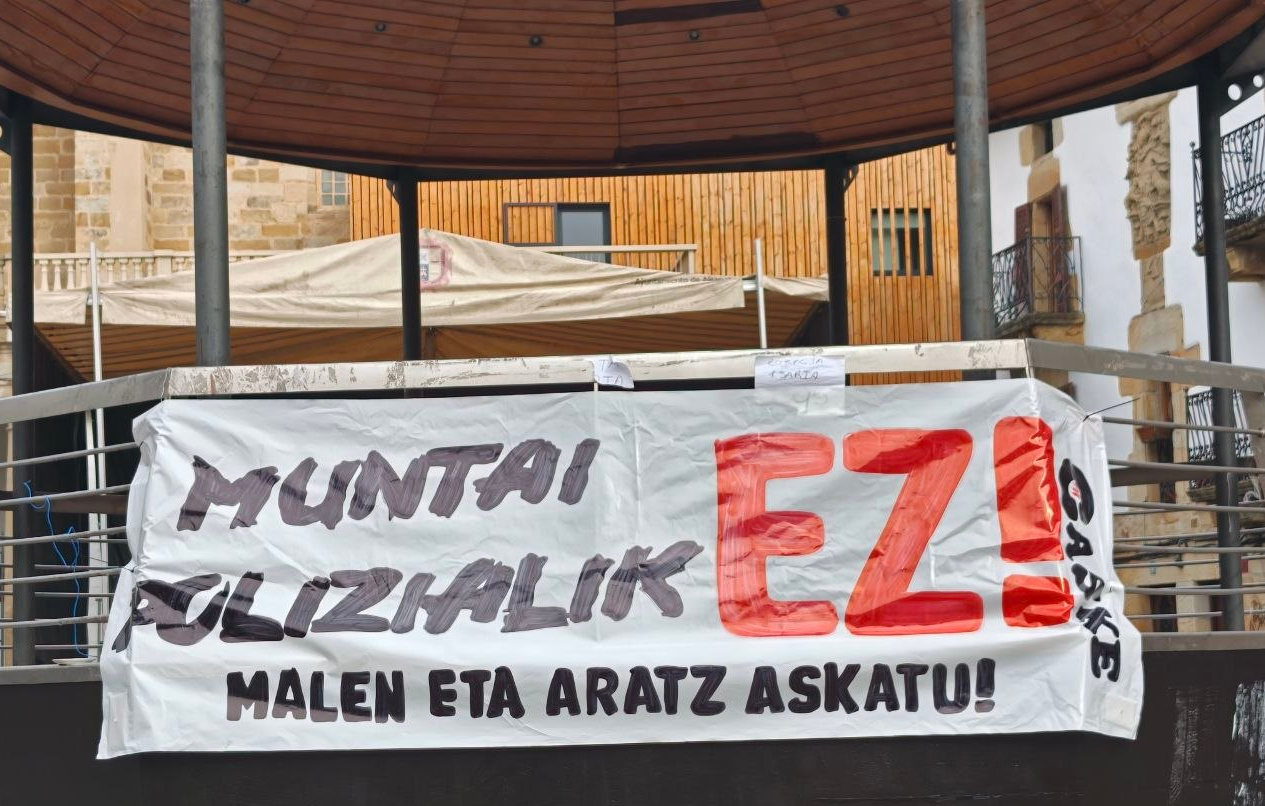
On 31 October, a demonstration in support of Malen G. and Aratz B. took place in Bilbao, with a considerable turnout despite the climate of fear created by Zupiria and others. Will you organise further mobilisations in support of your comrades?
For the time being, our objective is to raise public awareness of this case and these arrests, and to provide support both to the families and to the two people kidnapped by the Spanish State and held in a Madrid prison.
We are therefore going to develop the campaign within this framework so that people understand that what has been done is unacceptable.
We want people to mobilise and express their anger, as we have seen in other cases of repression in Euskal Herria. This is unacceptable because, as I said earlier, what they are doing is criminalising political activism.
If Malen and Aratz are convicted by the National Court in this case, anyone engaged in political activism in Euskal Herria could be convicted on the same grounds, because what is being criminalised is political activism itself.
Do you have any concrete plans?
We are going to organise open meetings in the different districts and establish networks of solidarity and support to achieve the objectives we have outlined.
Later on, because I expect this campaign to continue for a long time, there will be further mobilisations and a greater presence in the streets.
Is there anything else you would like to add?
We want to express our solidarity with Malen and Aratz, their families and their friends.
Taking this opportunity, we call upon the Basque Working People to ensure that this case does not go unnoticed.
People must mobilise because what is happening is unacceptable.
Today, it has affected these two comrades, but what is being criminalised is political activism.
Today, it is them. But if this case ends in a conviction, tomorrow it could be anyone.
EUSKAL SELEKZIOA: FREEDOM FOR MALEN AND ARATZ!
BILBAO: FREEDOM FOR MALEN AND ARATZ!
MALEN ETA ARATZ ASKATU!
### Related articles
* [Bilbao: Freedom for Malen and Aratz](https://
* [Amparo Lasheras: Malen and Aratz](https://
* [Koldo Tellitu: Chronicle of a Foretold Fabrication](https://
* [Aratz Estonba, lawyer: “Neither arms caches nor weapons”](https://
Source: Sare Antifaxista – 25 November 2026.
Translation note: The complete interview has been rendered in British English, preserving its political terminology and question-and-answer structure. Grammatical and pronoun errors in the supplied English passages have been corrected. The allegations and political assessments remain those of the interviewee and original publication; they have not been independently verified.